
Tips & Advice
Can You Split a Business to Avoid VAT? Yes… But Here’s the Catch

Published: 8 July 2025
Reading time: ~6 minutes
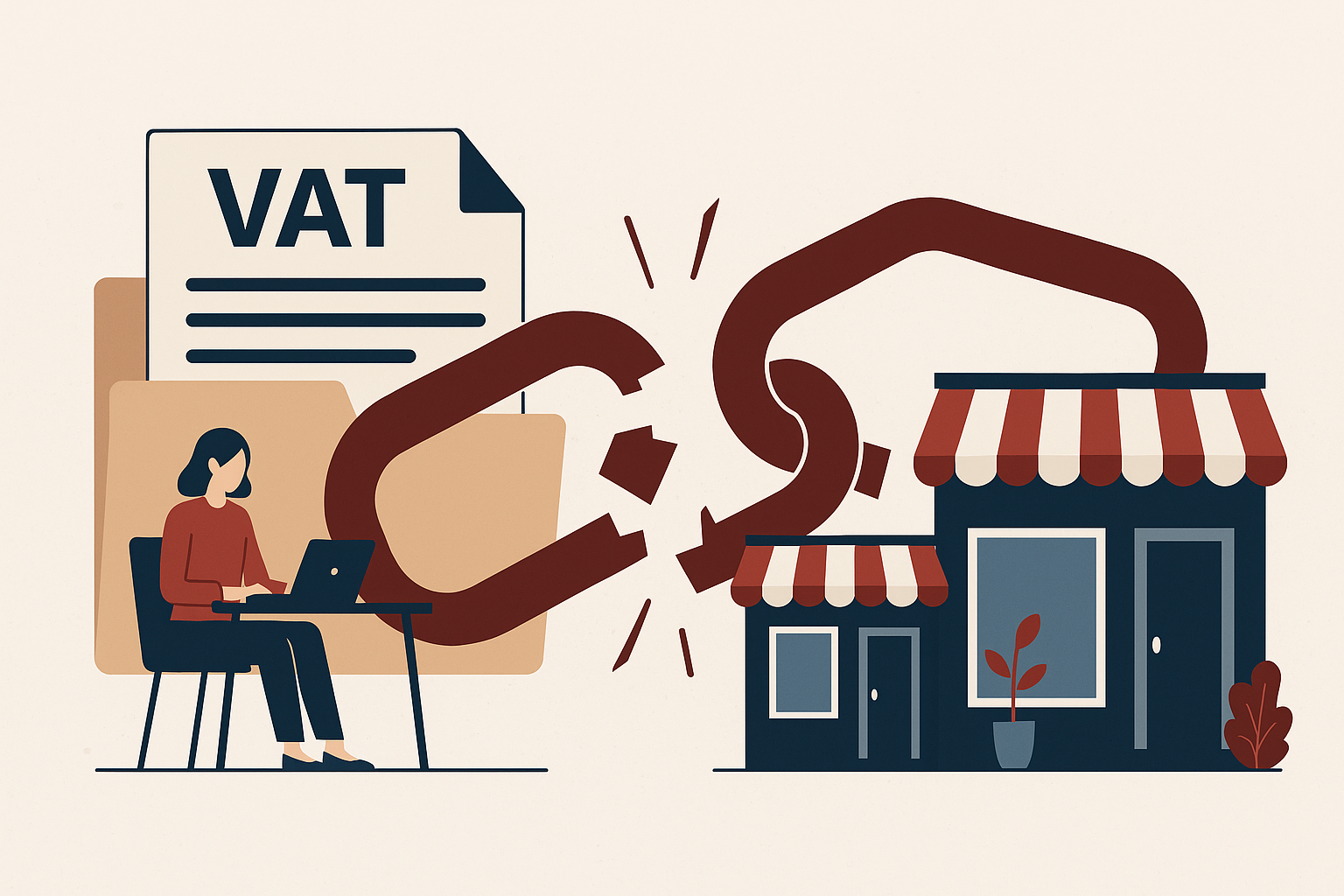
What on earth is VAT disaggregation?
Ever thought, “what if I split my business into two to dodge the VAT registration threshold?” That’s VAT disaggregation (or "artificial separation") and yes, HMRC is on to it.
In simple terms, it’s when one “business” masquerades as two (or more) to stay below the VAT radar.
Why some entrepreneurs take the plunge
VAT adds 20% to your prices. Suddenly your £100 widget hits the market at £120.
That extra sting can make customers run for the hills, especially when they're not VAT-registered themselves and can't claim VAT back.
Breaking into separate entities to keep your turnover below the VAT limit seems like a trick, but can get messy, fast.
When splitting is legit
You can lawfully separate activities; for instance, a property developer trading taxable supplies and a lettings business offering exempt rentals.
But HMRC may grill you on whether there’s financial, economic, or organisational overlap.
Watchpoints include:
- Shared bank accounts
- Common staff, offices, equipment
- Cross-promotion or joint marketing
- Personnel managing both entities
If all that exists, HMRC will likely treat it as one business and slap combined VAT liability, backdated penalties, and potentially more.
Real‑life examples of VAT disaggregation
A couple ran a hair salon and a beauty parlour in the same shop under different names and bank accounts but shared stylists. HMRC said no.
A pub owner tried splitting bar and catering under separate entities even though menus and staff overlapped. HMRC said nope.
Success story: a proper split
Meet Jane, she runs a residential lettings company (VAT‑exempt) and a commercial property development firm (VAT‑taxable).
Different premises, separate teams, no shared resources.
HMRC gave the thumbs‑up, disaggregation didn’t apply here
What HMRC can do
If HMRC concludes it’s artificial separation:
They can issue a Notice of Direction to treat it as a single taxable entity (Schedule 1 VAT Act 1994).
They can backdate VAT registration. The standard look-back window for late VAT registration is up to 4 years. However, in cases of deliberate fraud or evasion, HMRC can go back up to 20 years!
They can impose Failure to Notify penalties ranging from 10%-100% of unpaid VAT.
So, that “clever” move could cost tens of thousands.
How to (Legally) Separate Your Business for VAT
| Area | What You Should Do | Why It Matters |
|---|---|---|
| Legal Structure | Set up separate legal entities | Different legal status is the foundation of separation |
| Separate VAT Registration | Register each entity individually | Gives each entity a distinct tax identity |
| Business Names | Use unique trading names and branding | Avoids customer and HMRC confusion |
| Bank Accounts | Keep separate accounts for each business | Critical to show financial independence |
| Bookkeeping | Use different software & ledgers | Prevents overlap in audit trails |
| Premises | Operate from different locations | Helps prove economic separation |
| Staff | Hire different employees for each business | Supports organisational independence |
| Marketing | Separate websites, socials & campaigns | Avoids perceived overlap or shared identity |
| Client Contracts | Each business signs its own contracts | Proves commercial separation |
| Insurance | Maintain separate insurance policies | Confirms legal and operational separation |
| Revenue Streams | Avoid cross‑charging below market rate | Prevents artificial manipulation claims |
| Equipment | Use separate tools & tech | Avoids shared economic purpose |
| Contact Details | Unique phone numbers and emails | Reduces confusion for HMRC & clients |
| Internal Policies | Document how operations differ | Shows separation intent and execution |
| Commercial Logic | Split must serve a business purpose | Lack of logic = red flag |
| Shared Branding | Avoid appearing as part of the same group | Strengthens brand independence |
| Management | Separate directors or management roles | Avoids organisational overlap |
| Documentation | Keep records justifying split | Critical in an HMRC challenge |
| Timing | Split should align with growth, not avoidance | Poor timing raises suspicion |
| Customers | Have different customers for each entity | Proves commercial separation |
Our legal take
According to VAT law (VATA 1994, Sch 1, para 1A(2)), HMRC only needs to prove the different entities were "closely bound to one another" by financial, economic and organisational links to prove disaggregation.
They don’t need to prove that there was any intent to avoid VAT!
So leaving any one link in place is risky business.
Final word for business owners
VAT disaggregation is not a loophole.
 If splitting reflects true business strategy, you might be fine.
 If it’s just a dodge to avoid VAT, it's a red flag.
Make sure your structure proves independence in every sense. Stamp it with evidence and if you're uncertain talk to professionals like us at SCCS Accountants.
Bottom line
VAT disaggregation may look clever but it’s risky if your entities aren’t truly separate.
Ensure no shared bank, premises, staff, equipment, or marketing, and have commercial logic to back it up. Because if HMRC wants to merge you back together, you’ll wish you’d been prepared.
Need help untangling your VAT structure?
Contact us for expert advice, tailored to your setup (and VAT-compliant all the way).

Disclaimer
This article is provided for general informational purposes only and does not constitute tax, legal, accounting, or financial advice. The information is based on UK law and HMRC guidance as at the date of publication, but rules and interpretations may change. We do not accept any liability for actions taken, or not taken, based on this content. Always seek tailored advice from SCCS Accountants before making financial or business decisions.